

Has Russia Supplied Iran with Iskander-M Missiles? Capabilities, Facts and Regional Impact
Kazi Abul Monsur#
Iran’s Tasnim News Agency and several other Iranian media outlets have recently claimed that Russia has supplied Iran with the advanced 9K720 Iskander-M tactical ballistic missile system. However, Russia has not issued any official confirmation, and neither the United States, NATO, nor any independent international monitoring organization has verified the claim.
Nevertheless, the reports have sparked renewed debate among defense analysts worldwide. If the transfer is eventually confirmed, it could significantly alter the military balance of power in the Middle East.
What is the Iskander-M?
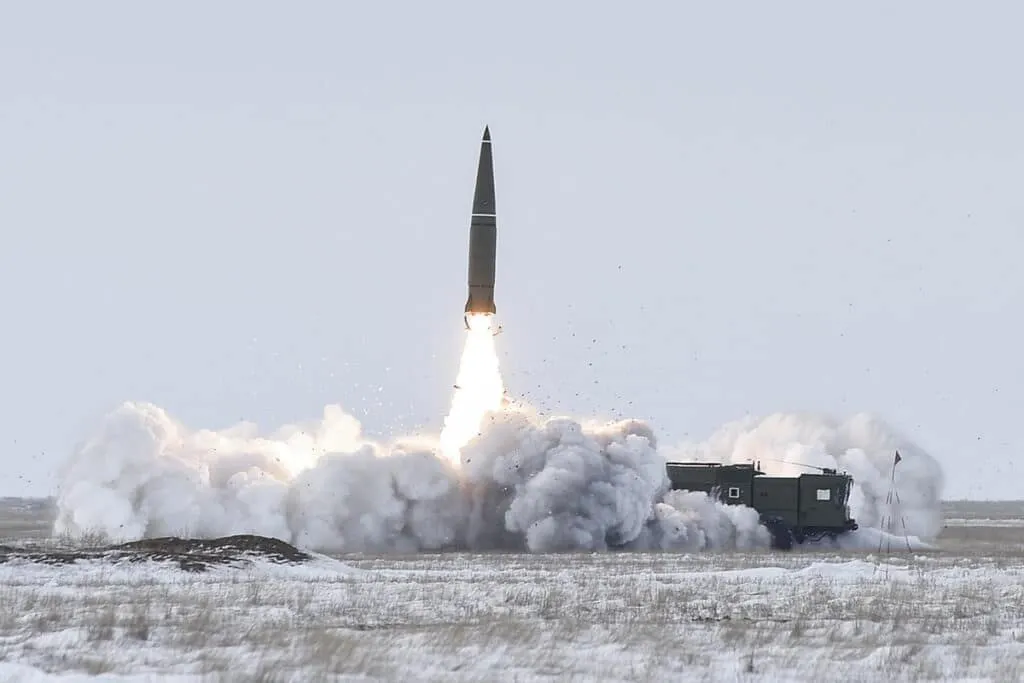
The 9K720 Iskander-M is a Russian-made Short-Range Ballistic Missile (SRBM) system, known by NATO under the reporting name SS-26 Stone.
Development of the project began during the Soviet era but was suspended following the collapse of the Soviet Union in 1991. Russia later revived the program, conducted its first successful test in 1996, and officially inducted the missile into military service in 2006.
Today, the Iskander-M is regarded as one of Russia’s most capable and reliable tactical ballistic missile systems.
Technical Specifications
The Iskander-M has an operational range of approximately 50 to 500 kilometers. It is capable of carrying warheads weighing up to 480 kilograms. According to Russian sources, the domestic military version can be equipped with both conventional and nuclear warheads.
The missile measures 7.3 meters in length and 0.92 meters in diameter. It is powered by a single-stage solid-propellant rocket motor.
Military analysts estimate that the missile can reach speeds of approximately Mach 6 to Mach 7.
Why Is It Considered So Dangerous?
According to defense experts, the Iskander-M’s greatest advantage lies not only in its speed but also in its ability to maneuver during flight.
Unlike conventional ballistic missiles that follow a largely predictable trajectory, the Iskander-M is designed to perform terminal maneuvers during the final phase of flight. Russia also claims that the missile can deploy decoys and employ electronic countermeasures, making it more difficult for enemy air and missile defense systems to intercept.
These features are considered among the primary reasons why the system is viewed as a highly capable battlefield weapon.
What Types of Targets Can It Strike?
The Iskander-M is primarily designed to destroy high-value military targets, including:
Air bases
Military headquarters
Missile defense systems
Radar installations
Ammunition depots
Command and control centers
Other critical military infrastructure
Types of Warheads
According to Russian military information, the Iskander-M can carry a variety of warheads, including:
High-explosive (HE)
Cluster warheads
Bunker-buster warheads
Thermobaric (fuel-air explosive) warheads
Nuclear warheads (Russian domestic military version)
Iskander-M vs. Iskander-E
Russia also produces an export version known as the Iskander-E.
Unlike the domestic Iskander-M, the Iskander-E has a maximum range of 280 kilometers and is designed to carry only conventional warheads, in line with international missile export restrictions.
The Iskander-M, by contrast, has a range of up to 500 kilometers and offers significantly greater operational capability.
Which Countries Operate the System?
The Iskander-M is currently operated by:
Russia
Belarus
The Iskander-E export version is known to be operated by:
Armenia
Algeria
Iran has not yet been officially recognized as an operator of the Iskander-M, as reports of its acquisition have not been independently verified.
Role in the Ukraine War
The Iskander-M gained global attention following Russia’s full-scale invasion of Ukraine in 2022. Numerous reports indicate that the missile has been used to strike Ukrainian air bases, military installations, ammunition depots, and critical infrastructure.
Although not every reported strike has been independently verified, the system has become widely recognized as one of Russia’s principal tactical strike weapons during the conflict.
How Strong Is Iran’s Indigenous Missile Arsenal?
Iran has spent decades developing one of the largest ballistic missile programs in the Middle East.
Its inventory reportedly includes several short-, medium-, and long-range missile systems, including Kheibar Shekan, Haj Qasem, Fattah, Sejjil, Emad, and Ghadr.
Among them, the Fattah missile has attracted international attention after Iran described it as a hypersonic missile, although that claim remains disputed by many defense experts.
Why Would the Iskander-M Matter to Iran?
Defense analysts argue that although Iran already possesses an extensive missile arsenal, the Iskander-M would provide an additional capability due to its high precision, rapid response time, and proven battlefield performance.
If the reported transfer is confirmed, the system could enhance Iran’s ability to conduct rapid and accurate strikes against regional military targets and strategic infrastructure.
What Could Be the Regional Impact?
Analysts believe that confirmation of an Iskander-M transfer to Iran could reshape the security landscape of the Middle East.
It could prompt Israel, U.S. forces stationed in the region, and Gulf Arab states to reassess their missile defense strategies and broader military planning.
Such a transfer would also be viewed as another indication of expanding military cooperation between Russia and Iran.
However, these strategic assessments remain hypothetical. As of now, there has been no independent international confirmation that Russia has delivered the Iskander-M missile system to Iran. Until credible evidence or an official announcement emerges, the reports should be treated as unverified claims rather than established fact.##